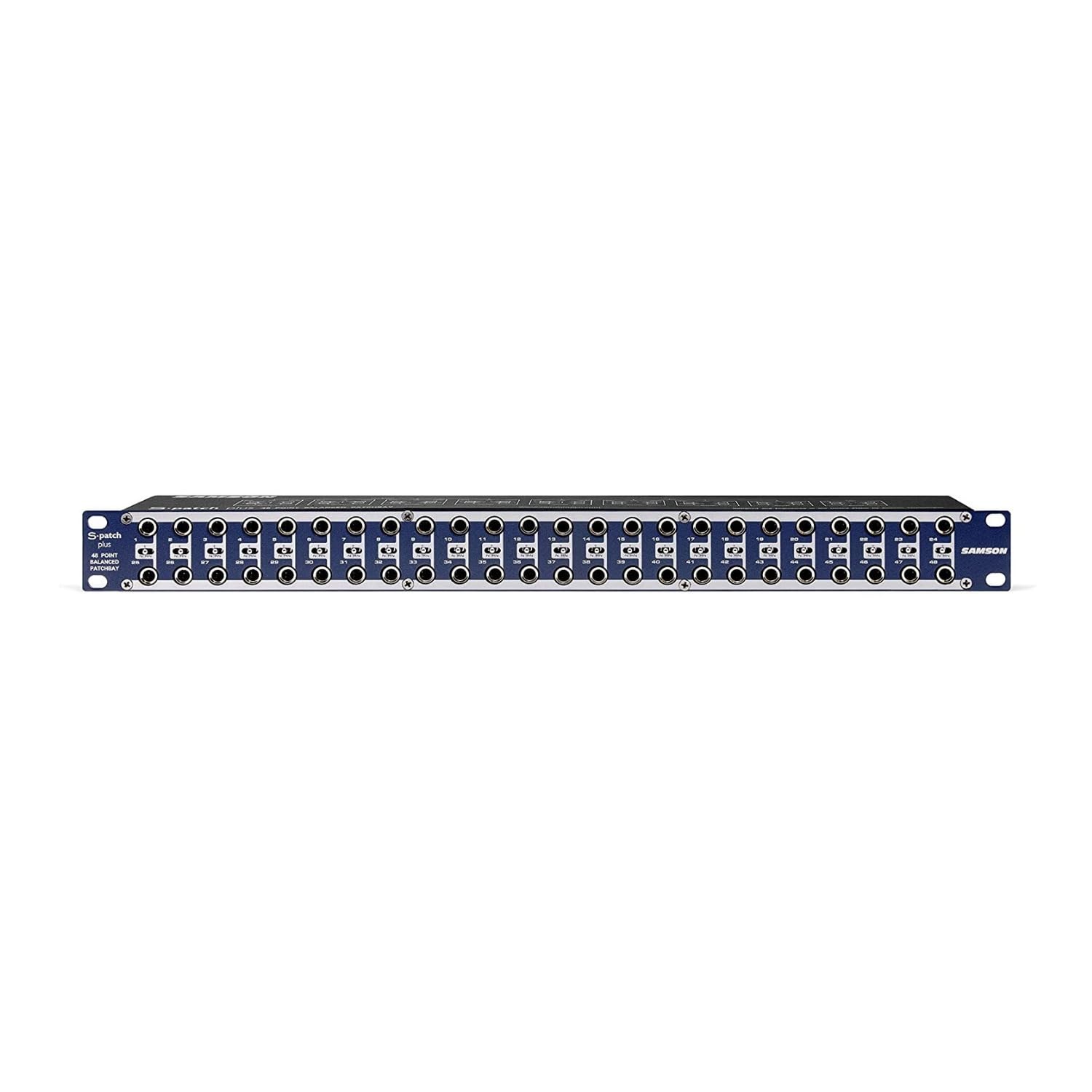
The Samson S-Patch Plus review is for studio owners looking to organize many audio connections in a single rack space.
Its 48 balanced patch points and front-panel routing switches can make it easier to change signal paths without reaching behind rack equipment.
Samson S-Patch Review Summary
The quick verdict
500+ ratings
Read Amazon ReviewsSamson S-Patch Plus
A useful fit for studio owners who want 48 balanced patch points and front-panel control over normal, half-normal, and thru routing.
- One-space rack unit with 48 fully balanced patch points.
- Quarter-inch TRS connections are provided on both the front and rear panels.
- Miniature front-panel toggle switches let each patch point pair use normal, half-normal, or thru operation.
- Thru mode routes the rear top connection to the front top connection, with the corresponding path reversed for the bottom row.

Pros
- High connection capacity in a single rack space.
- Front access can reduce the need to reach behind the mixer or rack when changing connections.
Consider before buying
- The 48-point capacity may be unnecessary for a small setup with few devices or infrequent repatching.
- A patch bay adds another layer to plan and label; buyers should map connections and routing modes before wiring the rack.
Read the full review summary
The S-Patch Plus brings 48 patch points to a one-space rack unit, with quarter-inch TRS connections on the front and rear.
That gives a studio a central place to connect gear and route signals, while keeping frequently used patching within reach.
The ability to set each patch point pair to normal, half-normal, or thru operation adds flexibility for different signal-flow plans.
This design suits recording rooms and equipment racks with enough connected hardware that rear-panel repatching has become a routine inconvenience. It is especially worth considering if you want to organize signal paths before adding more gear.
The front-panel switches make routing behavior configurable, though buyers should map their intended connections and check the balanced TRS cabling requirements before integrating it.
The buying factors
Samson S-Patch Scorecard
Editorial scores reflect listed features and buyer fit; they are not laboratory measurements or customer ratings.
Routing flexibility
Three selectable modes for each patch point pair support a range of signal-flow arrangements.
Connection capacity
Forty-eight balanced patch points offer substantial routing capacity in a one-space rack unit.
Front-panel access
The front connections and switches put patching and mode changes within reach.
Rack efficiency
The one-space format consolidates many connections in a compact rack footprint.
Setup simplicity
The centralized layout can simplify repatching, but a larger patch system still benefits from careful labeling and planning.
Fit for small setups
Its capacity and multiple routing modes may be more than a compact rig needs.
Key Features and Specifications of Samson S-Patch
- One-space rack unit with 48 fully balanced patch points.
- Quarter-inch TRS connections are provided on both the front and rear panels.
- Miniature front-panel toggle switches let each patch point pair use normal, half-normal, or thru operation.
- Thru mode routes the rear top connection to the front top connection, with the corresponding path reversed for the bottom row.
- Designed as a central connection point for recording signal flow and effects-chain routing.
Pros and Cons of Samson S-Patch
Pros
- High connection capacity in a single rack space.
- Front access can reduce the need to reach behind the mixer or rack when changing connections.
- Selectable routing modes support different patching approaches.
- Balanced TRS connections suit studios that use balanced cabling throughout their signal paths.
Consider before buying
- The 48-point capacity may be unnecessary for a small setup with few devices or infrequent repatching.
- A patch bay adds another layer to plan and label; buyers should map connections and routing modes before wiring the rack.
- The design uses quarter-inch TRS connections, so confirm that this matches the connectors and cabling in the intended setup.
Who Should Buy Samson S-Patch?
Good fit
Consider the S-Patch Plus if your rack contains multiple pieces of audio equipment and you regularly change which devices feed one another.
Bringing 48 balanced patch points to the front can make routine repatching more convenient and help keep the rack's rear connections undisturbed.
It is also a strong candidate when you want to define normal, half-normal, or thru behavior for individual patch point pairs.
Before buying, sketch the signal flow you want, confirm the rack has a space available, and check that quarter-inch TRS connections suit the gear and cables you plan to use.
Who should skip it
Skip this model if your rig has only a few fixed connections and you rarely need to change its routing. In that situation, 48 patch points and configurable modes may add more setup work than practical benefit.
Look for a different connection format if your intended equipment and cabling do not use quarter-inch TRS connections and you do not want to adapt your signal paths.
How the Samson S-Patch Plus Fits a Studio Rack
Capacity and rack planning
The 48 patch points make this a substantial routing hub for a recording setup, while the one-space format limits the rack space it occupies.
Capacity is most useful when you have enough connected gear or regular routing changes to justify organizing those paths centrally. Plan which devices will connect before installation so the available patch points serve real signal-flow needs.
Choosing a routing mode
Normal, half-normal, and thru settings let each patch point pair behave differently. That means the same unit can support more than one routing arrangement across the rack.
Decide how each pair should behave for your workflow, then set the front-panel toggles accordingly; the thru path follows the top and bottom connection directions described for the unit.
Front access and cabling
Front connections and switches put both patching and mode selection in reach, addressing the practical hassle of working around the back of a rack.
The unit uses balanced quarter-inch TRS connections at both ends, so check connector compatibility and cable availability as part of installation planning. Clear labeling can also help make a dense patch layout easier to follow.
Alternatives to Samson S-Patch
No alternative model is recommended here. Compare connection format, point count, rack space, and routing modes before choosing another patch bay.
Is Samson S-Patch Worth It?
The Samson S-Patch Plus is worth considering for studios that need a central, accessible way to manage many balanced signal connections.
Its 48 patch points, one-space rack format, and selectable routing modes make it a flexible option for evolving signal paths.
Its value depends on having enough gear and repatching needs to use that capacity.
Confirm the quarter-inch TRS format fits your setup and plan your routing before installation; for a small rig with mostly fixed connections, a large configurable patch bay may be more than you need.
Your review at a glance
500+ ratings
Read Amazon ReviewsSamson S-Patch Plus
A useful fit for studio owners who want 48 balanced patch points and front-panel control over normal, half-normal, and thru routing.
- One-space rack unit with 48 fully balanced patch points.
- Quarter-inch TRS connections are provided on both the front and rear panels.
- Miniature front-panel toggle switches let each patch point pair use normal, half-normal, or thru operation.
- Thru mode routes the rear top connection to the front top connection, with the corresponding path reversed for the bottom row.